

Optical Heart Rate Monitors — Top 5 Picks in the USA for 2026
Published on Tuesday, January 27, 2026
Optical heart rate monitors use light-based sensors to measure pulse and continuous heart rate without electrodes. They are most commonly embedded in wrist-worn fitness trackers and smartwatches and rely on photoplethysmography, or PPG, to detect small changes in blood volume under the skin. In the USA market, consumers favor optical monitors for convenience, comfort, and all-day tracking ability. Key purchase drivers include battery life, form factor, companion apps and analytics, ecosystem compatibility with phones and fitness platforms, and evidence of accuracy for everyday activities. Buyers who prioritize long-term trend tracking, sleep and recovery insights, and easy daily wear often choose optical devices, while competitive athletes and users needing beat-to-beat clinical precision may still opt for chest straps or ECG-based solutions. Recent market trends through 2024 show growing demand for multi-sensor devices, improved algorithms that reduce motion artifact, and increased interest in features that support telehealth and wellness coaching.
Top Picks Summary
Garmin HRM-Pro Plus
Garmin’s HRM‑Pro Plus is the market leader for athletes who prioritize absolute accuracy and advanced running metrics; although it is a chest‑strap ECG sensor rather than an optical armband, it delivers superior raw HR fidelity, running dynamics and ultra‑stable Bluetooth/ANT+ streaming. It sits at a higher price point than the optical options here but justifies that premium with deeper device integrations, onboard history and pro‑grade metrics that many endurance athletes and coaches prefer.

Polar Verity Sense
Polar’s Verity Sense is best‑in‑class among optical armbands thanks to a refined optical algorithm, long battery life and flexible mounting options that work across sports and swimming. It typically offers better optical consistency and standalone memory than budget armbands while remaining more affordable and versatile than many chest‑strap systems for cross‑discipline athletes.

Wahoo TICKR FIT
Wahoo’s TICKR FIT delivers strong value as an optical armband with reliable Bluetooth/ANT+ connectivity, a slim, comfortable profile and excellent indoor‑training integration—making it a popular pick for cyclists, rowers and studio users. Priced below many premium armbands and chest straps, it trades a small amount of high‑motion optical refinement for affordability and convenient app ecosystem support.

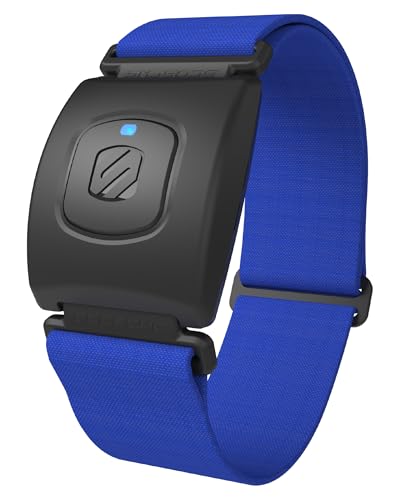
Scosche Rhythm+ 2.0
Scosche’s Rhythm+ 2.0 is a rugged, high‑sampling‑rate optical armband that excels in comfort and durability during high‑intensity and sweat‑heavy workouts, often matching pricier competitors in motion‑heavy accuracy. It’s a cost‑effective choice for athletes who want gym‑proof hardware and broad device compatibility without paying extra for onboard memory or manufacturer‑locked features.
Polar OH1
Polar’s OH1 is a compact, proven optical sensor that provides reliable heart‑rate tracking at a lower price point; its waterproof design and ease of placement on the arm or temple make it a practical starter or backup unit. While it lacks some of the newer memory and mounting versatility of the Verity Sense, it still uses Polar’s trusted algorithms and offers solid battery life for buyers focused on cost‑effectiveness.

Science Behind Optical Heart Rate Monitoring
Optical heart rate monitors use photoplethysmography. A light source shines into the skin and a detector measures the amount of light that is reflected or absorbed as blood volume pulses with each heartbeat. Signal processing and algorithms convert those light variations into a heart rate reading. Advances such as multi-wavelength sensors, on-device accelerometers, and machine learning models help filter motion noise and improve accuracy across different skin tones and activity types. While optical systems are noninvasive and excellent for continuous, day-to-day monitoring, their performance varies by activity intensity and device quality. Evidence from clinical and laboratory studies indicates good agreement with reference devices at rest and during steady-state exercise, with larger errors possible during abrupt, high-intensity motion or when fit is suboptimal.
Photoplethysmography (PPG) measures blood volume changes using light and is the fundamental method for most optical monitors.
Multiple peer-reviewed studies report strong agreement between optical monitors and ECG or chest-strap references at rest and during steady-state activity.
Accuracy typically decreases during rapid arm movement, high-intensity interval training, or when the sensor fit is loose.
Multi-wavelength sensors and improved algorithms reduce errors related to skin tone and ambient light.
Some wearable makers have achieved regulatory clearances for specific cardiac features, showing that certain optical applications can meet clinical standards when validated.
Frequently Asked Questions
Which optical heart rate monitor should athletes buy?
For athletes who want maximum raw HR fidelity and advanced running metrics, choose Garmin HRM‑Pro Plus, a chest‑strap sensor delivering ECG-like accuracy with Bluetooth and ANT+ broadcasts and a 4.7 rating.
How deep can Polar Verity Sense swim?
Polar Verity Sense is waterproof to 50 meters, with a forearm optical sensor made for pool and open-water swims, plus Bluetooth and ANT+ pairing and internal memory; it has a 4.5 average rating.
Is Wahoo TICKR FIT cheaper than Polar Verity Sense?
Yes—Wahoo TICKR FIT costs $89.99 USDwhile Polar Verity Sense costs $104.95 USDand the Wahoo armband streams optical PPG heart rate via Bluetooth and ANT+ with a 4.3 average rating.
Do these monitors record sessions without my phone?
Polar Verity Sense records sessions to internal memory for later sync while also pairing via Bluetooth and ANT+, with a 4.5 rating; Garmin HRM‑Pro Plus stores running dynamics for later sync too.
Conclusion
Optical heart rate monitors are a practical, noninvasive choice for everyday fitness and wellness tracking in the USA. We hope this overview helped you understand the category and what to consider when choosing a device. If you did not find what you were looking for, you can refine or expand your search using the search function to filter by features, activity type, or accuracy needs.